
Learning boating right of way rules is one of the most important elements of being on the water. Luckily, most common boat right of way rules are simple once you learn the three possible situations: meeting head-on, crossing, and overtaking another boat.
While you might hear people refer to “right of way boating” or “right of way” on the water, the official United States Navigation Rules refer to give-way vessels and stand-on vessels instead of one boat having a clear “right.” As the U.S. Coast Guard states, the rules themselves grant no “right of way,” but rather, place responsibilities upon the vessels’ operators to take preventative action to avoid collisions.1 Simply put, just because you know who has to give-way and you have right of way on a boat doesn’t mean you should speed towards a collision. Always practice safe boating and navigation.
Who Has the Right of Way When Boating?
So you may be asking: ”Which boat has right of way?” It depends. The right of way rules designate which boat should normally give-way, and which boat should normally maintain course and speed. These responsibilities are laid out for typical recreational boating situations like head-ons, crossings, and overtaking.
For starters, think of right of way boating rules like this:
Give-way vessel: Steer clear of the other boat. Take early and significant action to avoid the other vessel.
Stand-on vessel: Maintain course and speed, but continue to watch what happens.
Both operators: Keep a proper lookout and take action to avoid collision if needed.
These concepts are the foundation of boating navigation rules as well as the sailing vessel rules of the road, sometimes referred to as the “boating rules of the road” or “rules of the road boating.”
What Is a Give-Way Vessel?
A give way vessel is the one that must give way and keep clear of another vessel.2
The give way vessel should act well in advance to avoid boats colliding. Any turn or reduction in speed should be obvious enough for the other operator to recognize what you’re doing. As a recreational boater, the rule of thumb is not to leave the other operator guessing about your intentions.
The give way vessel responsibilities are:
Keep clear of the stand-on vessel
Take early and significant action
Make obvious changes in course or speed
Allow enough room for the stand on vessel to pass
Continue to monitor the other vessel
These are some of the basic guidelines to marine right of way rules when navigating with multiple boats in a crowded area. These principles are part of the broader marine navigation rules that govern how vessels interact and maneuver on the water.
What Is a Stand-On Vessel?
A stand on vessel, also referred to as a stand-on boat, is the vessel that has the right to keep its course and speed in relation to another vessel which must give-way. Note that "stand-on" doesn’t mean "sit back and watch."
The responsibilities of the stand on vessel are to maintain a proper lookout and to watch the give-way vessel to ensure that it’s taking appropriate action to avoid crossing ahead; however, the stand on vessel responsibilities don't end with maintaining course and speed. The operator must continue watching the developing situation and be prepared to take action if a collision becomes unavoidable.
Understanding the difference between give way vs stand on vessel helps beginners know when to maintain course and when to act. According to the Navigation Rules, however, if it becomes apparent that the give-way vessel isn’t taking appropriate action, the stand-on vessel may take action to avoid collision. If the vessels become so close that action by the give-way vessel alone will not prevent a collision, the stand-on vessel must take action. This is an important navigation rule for boaters to understand. Just because you’re the stand on vessel doesn’t mean you can stay on your course if that will result in a collision.
Understanding stand on vs give way vessel responsibilities is essential for knowing which boat should normally maneuver and which boat should normally maintain course and speed.
Head-On Boating Rules
The easiest head on boating rules to remember are simple: all power-driven vessels turn to starboard.
When two power-driven boats meeting head on approach one another on reciprocal or nearly reciprocal courses, both power-driven vessels should alter course to starboard and pass port-to-port. [2]
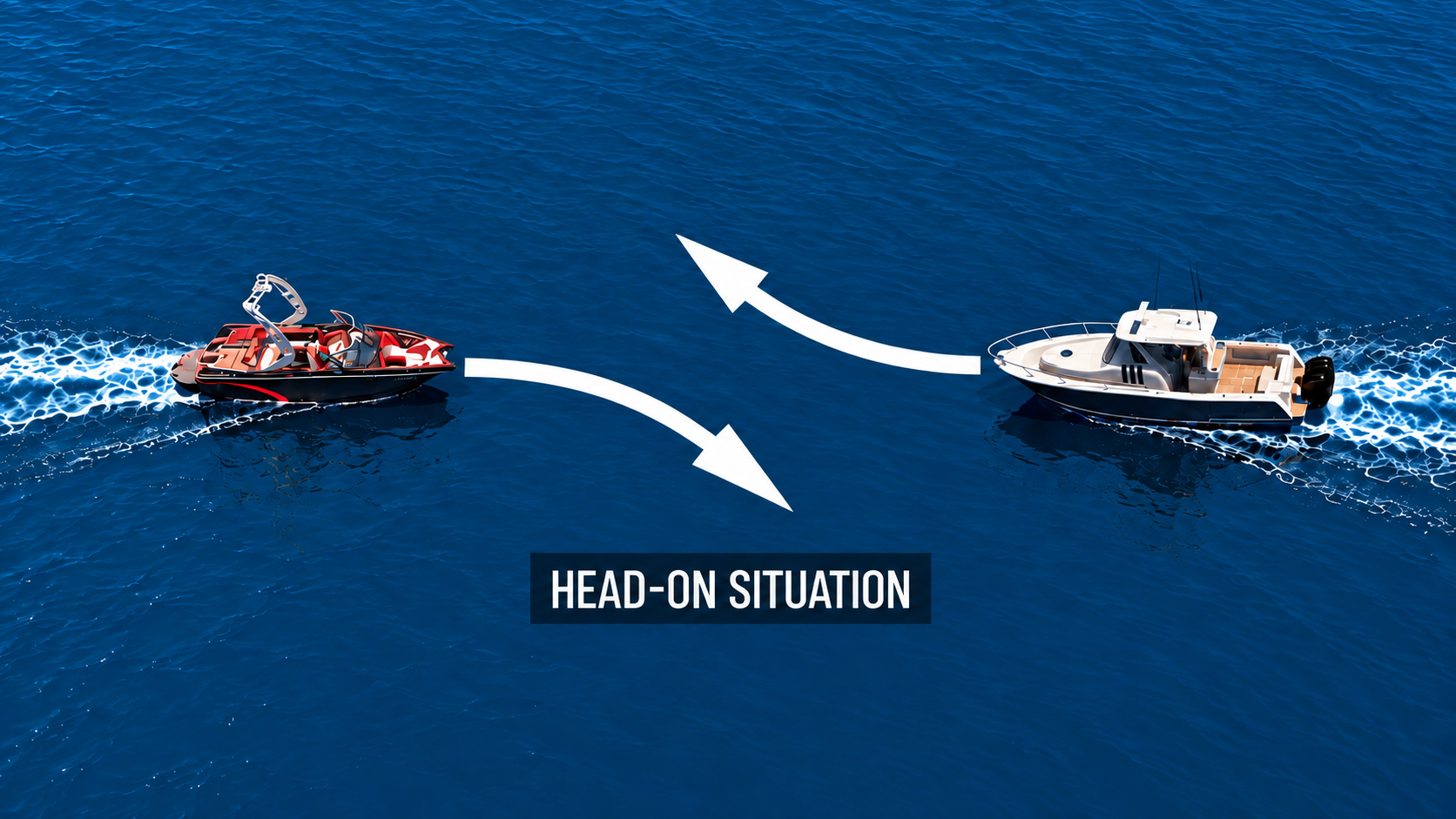
Of course, if you're ever in doubt about whether you're dealing with head-on boat rules or another type of encounter, the Navigation Rules state that you should assume it is head-on and act accordingly. That's why knowing predictable boat movements is so important when operating recreational watercraft.
Crossing Rules: Which Boat Gives Way?
A crossing situation boating definition refers to when two power-driven boats approach each other from directions that intersect, not from dead ahead.
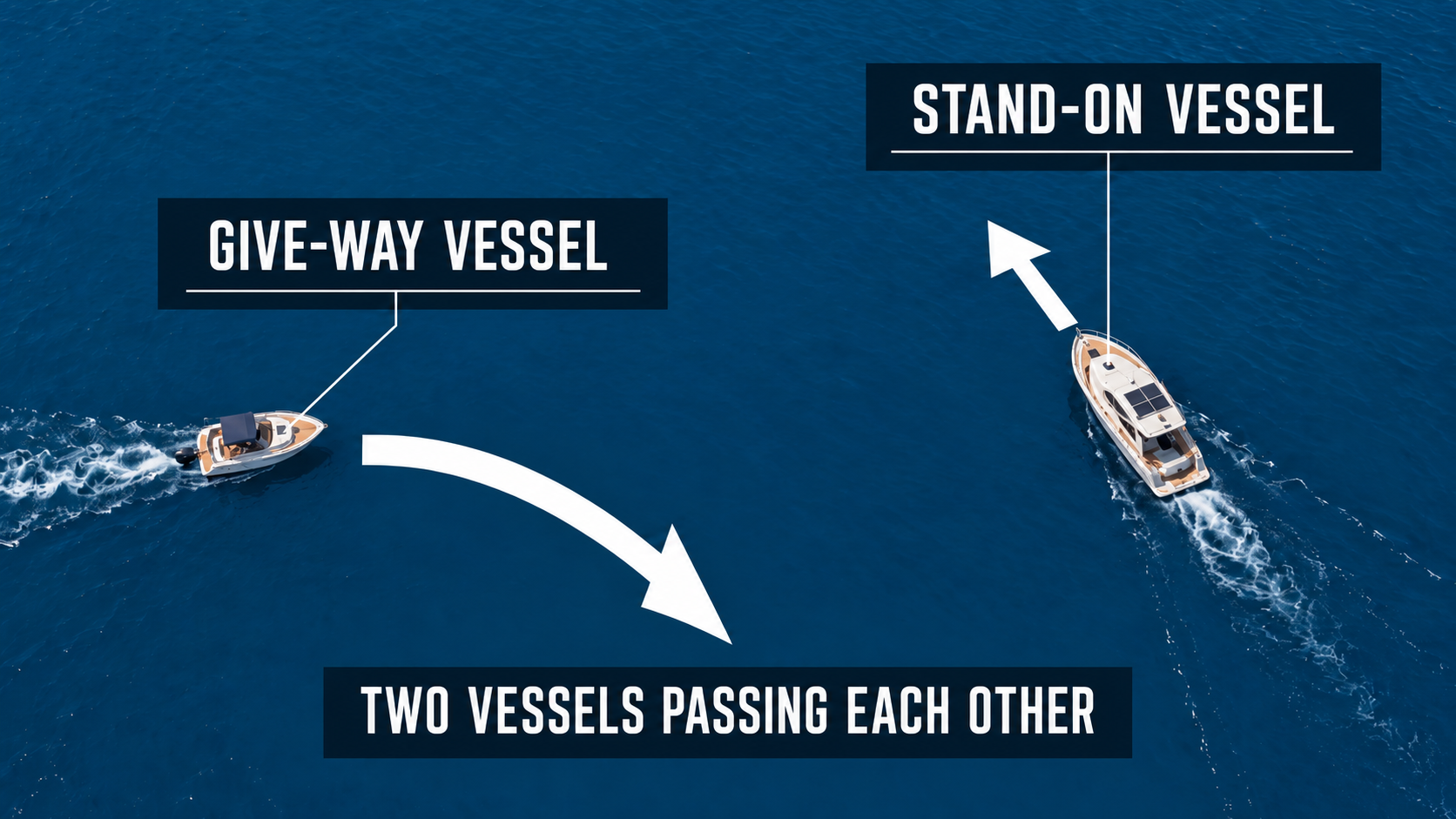
Remember this rule for boat crossing rules: If there is another power-driven vessel on your starboard side, you’re normally considered the give-way vessel. Keep out of the way of the other vessel and avoid crossing ahead of the other power-driven boat unless it is safe to do so.
If you learn port vs starboard boating rules, you'll never forget which side of the boat to look on when determining who has right-of-way in a crossing situation. Here's a hint:
Starboard = right.
Port = left.
Understanding port and starboard right of way can help you quickly determine which vessel should give way when two power-driven boats approach each other on crossing courses.
If another power-driven boat is approaching from your right side, you should remember the starboard boat rule. You must give-way in most crossing situations involving two power-driven vessels. You can also think of it as port and starboard boat right of way: The boat that sees the approaching vessel on its starboard side is usually the one that must keep clear.[2]
Overtaking Rules: The Passing Boat Keeps Clear
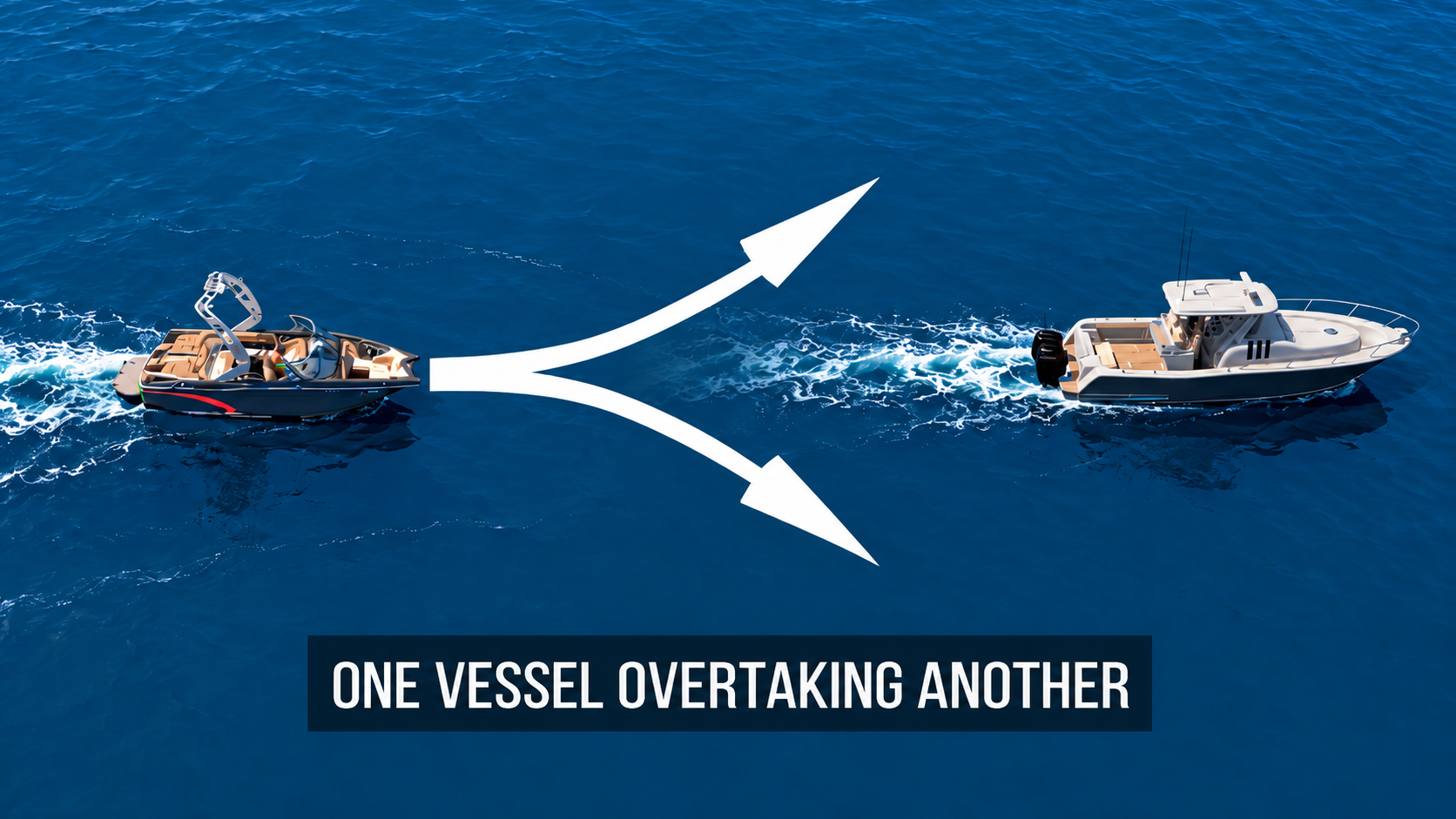
The basic principle of the overtaking boat rules is simple: the overtaking boat must keep clear.
This boat overtaking rule means the passing vessel is responsible for choosing a safe path and maintaining enough distance until it has completely cleared the other boat.
If there’s any doubt as to whether you’re overtaking another boat, you should assume that you are. The overtaking vessel must keep clear until she is past and clear of the vessel being overtaken.
Knowing these “passing another boat” rules will help you when applying boat passing rules and boating passing rules to real-life situations. When passing, allow plenty of room, make your moves predictable, and be mindful of your wake. Passing too fast and close to another boat can create an uncomfortable or unsafe situation even if the pass is technically allowed.
Powerboat vs. Sailboat Right of Way
One navigational rule that many people believe is “a sailboat always has right of way over a powerboat,” but that’s not necessarily always true. Generally, boats under power must yield to sailboats operating under sail, but they must also yield to boats not under command, boats restricted in their ability to maneuver, and boats fishing, depending on the applicable Navigation Rules.
A sailing vessel that’s being powered by its engine is no longer considered a sailing vessel under the Navigation Rules, and instead is considered a power-driven vessel. Therefore, sailboat vs powerboat right of way doesn’t depend on whether a boat has sails. Instead, it depends on whether a vessel is operating as a sailing vessel or a power-driven vessel.
Understanding these differences is an important part of powerboat navigation rules, particularly when a recreational powerboat encounters a sailing vessel, fishing vessel, or vessel with limited ability to maneuver.
Understanding Different Types of Vessels
Navigation Rules have very specific definitions that can change who has responsibility. Here are the ones every boater should know:
Power-driven vessels: Any vessel that is propelled by machinery
Sailing vessels: Any vessel that’s under sail and isn’t using machinery for propulsion
Vessels not under command: Any vessel that can’t maneuver as the rules require due to exceptional circumstances
Vessels restricted in their ability to maneuver: Any vessel whose work makes it difficult to maneuver how the Navigation Rules require
Vessels engaged in fishing: Any vessel limited in its ability to maneuver due to fishing as defined by the rules
Understanding this simple vessel hierarchy can help you understand why the rules for navigating a powerboat change based on what another vessel is doing.
Right of Way in Narrow Channels
Narrow channel boating rules require additional vigilance because you may encounter vessels that have limited ability to maneuver.
When traveling in a narrow channel or fairway, Rule 9 states that a vessel should normally stay as close as is safe to the outer limit of the channel or fairway on the vessel's starboard side.[1] A vessel of less than 65 feet in length and sailing vessels shouldn’t impede the passage of any vessel that can safely only navigate within the narrow channel or fairway.
This is especially important near crowded coastal waterways, bridges, marinas, and inlets. Always keep a proper lookout and safe speed, and give a wide enough berth to allow larger or less maneuverable vessels the space they need.
For boaters in Florida, this is especially important. The Coast Guard has reminded recreational boaters that maintaining a proper lookout includes those operating recreational boats and not just commercial vessels. Operators in Florida are specifically required to operate their vessel in a careful and prudent manner considering other vessel traffic and surrounding conditions.[3] Florida law follows the Federal Navigation Rules.
What If You’re Unsure Who Should Give Way?
When you find yourself asking who has the right of way on the water but you're still not sure who it is, don't take a chance that you're right.
Instead:
Slow down when it is safe to do so
Keep an eye on the other vessel
Don't make erratic moves
Don't change course suddenly in a way that may confuse the other vessel
Allow plenty of space to move
Take evasive action if you have to
You can slow down, stop, or even reverse your propulsion if necessary to avoid a collision or allow more time to figure out who has the right of way, according to The Navigation Rules. That's the basic idea of boating collision avoidance – take reasonable action to avoid boat collisions rather than relying on another operator to make the correct move.
Common Boating Right of Way Mistakes
Boaters who know the rules can still do the wrong thing when traffic is heavy.
Common mistakes include:
Believing the largest recreational vessel has right-of-way automatically
Believing that the stand-on vessel need not pay attention to an impending danger
Cutting across the bow of another vessel
Passing too closely
Forgetting that the overtaking vessel always keeps clear
Mixing up port and starboard
Making late course corrections
Failing to keep a proper lookout
Assuming that another operator knows what you want to do
Good boating traffic etiquette enhances the rules. Operating in a predictable and courteous manner allows everyone more time and room to react.
Quick Boating Right of Way Cheat Sheet
| Situation | Give-Way Vessel | Stand-On Vessel | Basic Action |
| Head-on | Both power-driven vessels | Neither | Both alter course to starboard and pass port-to-port |
| Crossing | Vessel with the other boat on its starboard side | Other power-driven vessel | Give-way vessel takes early, clear action |
| Overtaking | Overtaking vessel | Vessel being overtaken | Passing boat keeps clear until safely past |
| Powerboat vs. sailing vessel | Generally, power-driven vessel | Sailing vessel operating under sail | Powerboat keeps clear, subject to the applicable Navigation Rules |
Powerboat keeps clear, subject to the applicable Navigation Rules
These safe boating rules are a starting point and are not a substitute for learning the complete Navigation Rules.
Know the Rules Before Taking the Helm
Learning and understanding boating rules for beginners is an important first step to being confident on the water.
Before you go out, familiarize yourself with the recreational boating rules that apply to you, as well as any local requirements and boat traffic rules for the waters where you'll be boating. If you boat in Florida, make sure to read Florida's recreational boating requirements and regulations. Learning basic recreational boat navigation before you operate independently can also help you recognize common traffic situations and respond appropriately.
Your Boat Club's guide to common boat rental mistakes can help you prepare, while boat rental experience tips offer additional guidance for getting comfortable on the water.
If you're boating in coastal areas, you can also learn about the differences between locations with Your Boat Club's guide to ocean boating vs. lake boating.
For more information about applicable requirements, review Your Boat Club's boating rules and regulations.
Before departure, Your Boat Club’s expert staff are available to review navigation rules, answer questions, and share practical tips specific to your boating area. This guidance can help you understand local waterway conditions, identify potential hazards, and feel more prepared before heading out.
Your Boat Club also provides all members with a comprehensive on-the-water orientation to help them become familiar with their boat and build confidence before departure. This hands-on experience helps members understand essential boat operations, safety procedures, and navigation practices so they can enjoy their time on the water more confidently and responsibly.
The big lesson with all these rules is to combine knowledge with good judgment. Knowing who has the right of way on a boat isn't a contest to see who can go first. You learn when to yield, when to hold your course, and when everyone needs to take action to ensure waterway safety.
FAQs About Boating Right of Way Rules
Which boat has the right of way?
It depends on the circumstances. The Navigation Rules are designed to assign responsibilities between vessels and don’t grant boats an absolute "right" to do something. If you find yourself in a crossing situation with another power-driven vessel, the boat that has the other boat on its starboard side usually yields.
What is a give-way vessel?
A give-way vessel is the vessel required to keep clear. It should take early and substantial action to keep well clear of the other vessel.
What is a stand-on vessel?
A stand-on vessel is generally the vessel that maintains course and speed while monitoring the situation. It must still take action if necessary to help avoid a collision.
Who gives way when two boats cross?
For two power-driven vessels in a standard crossing situation, the vessel that has the other vessel on its starboard side gives way and should avoid crossing ahead when circumstances permit.
What happens when two boats approach head-on?
Both power-driven vessels should alter course to starboard so they pass each other on their port sides.
Who has the right-of-way when one boat is overtaking another?
The overtaking vessel must keep clear of the vessel being overtaken and remains responsible for doing so until it is finally past and clear.
Does a sailboat have the right of way over a powerboat?
Except where the rules or the circumstances dictate otherwise, a power-driven vessel should keep out of the way of a sailing vessel under sail. A sailboat under power is considered a power-driven vessel.
Which side should boats pass each other on?
In a standard head-on meeting between two power-driven vessels, both should alter course to starboard so they pass port-to-port.
What should you do if another boat doesn’t give way?
Just because you expect the other boat to give way doesn't mean you should continue ahead toward a collision. Ease back or steer away to avoid the collision, while keeping an eye on the other boat.
Article Sources
United States Coast Guard, Navigation Rules Frequently Asked Questions, https://www.navcen.uscg.gov/navigation-rules-faqs. Accessed September 29 2026.
United States Coast Guard Amalgamated Navigation Rules International & U.S. Inland, https://navcen.uscg.gov/navigation-rules-amalgamated. Accessed September 29 2026.
Florida Fish and Wildlife Conservation Commission Boating Regulations, https://myfwc.com/boating/regulations, July 2025. Accessed September 29 2026.
